
Select your location to see local listings
The Complete Kano Jiu-Jitsu
¢ Not all text in English are in public domain.
© This webpage is not in the public domain.
© The Malayalam text is copyrighted.
This webpage has been published on the 5th of July 2026.
VICTORIA INSTITUTIONS
Printed versions of all books are available here.
All books in webpage versions are available here.
📍 Fort Cochin
Not your location?
Warning
Any martial art can be dangerous if it is practised without proper care. Never do anything that could injure you or your partner.
Always train with the proper equipment — judo mats, judo dress, head protectors, face shields and the like — and under proper supervision.
Do not use these skills on other people merely to show what you can do. If something goes wrong, it can end in a police case and criminal charges.
If anyone is injured, get medical help at once. In India, dial 112 or 108.
Some passages of the 1905 original, including its chapter on kuatsu, have been left out of this edition, and cautions have been added where danger remains. Some equipment links above are Amazon affiliate links, and a purchase made through them may earn this site a small commission.
This is a far more ambitious and comprehensive attempt at a descriptive interpretation of the Japanese art of jiu-jitsu, or jiudo, than was undertaken in the writer's earlier volumes on the subject. Yet this larger and final volume on the subject was to be expected, and probably will be welcomed, for Americans are famous for their desire to go thoroughly to the bottom of things.
This volume, therefore, presents, in its entirety, the Kano system of jiu-jitsu, devised by Professor Jiguro Kano, with the additions thereto that have been made by those famous jiu-jitsians, Hoshino and Tsutsumi. Since the adoption of the Kano system in Japan as the official jiu-jitsu of the government in the army, navy, and police departments, the older and greatly inferior systems have begun to drop into disuse. The newer generation in Japan is devoting its attention wholly to the Kano methods.
This system begins with the simplest of combat tricks and progresses by degrees to tricks that may be made, in stress of dire necessity, most disastrous and even deadly. Yet it must not be inferred from this that the practice of jiu-jitsu is dangerous. Far from it! The writer has in his desk at the moment of writing a manuscript copy of a report made to the War Department by Colonel Oliver E. Wood, U. S. military attaché at Tokio, in which the statement is made that, out of four thousand pupils who attended the Kano school, not one was permanently injured.
In friendly contests the more serious tricks of jiu-jitsu are not practised with any intention of causing harm. Between Japanese students the tricks are practised lightly and swiftly, yet with care not to cause the injuries that would result from a severe application of the work.
Only the most advanced pupils are taken into the most serious and deadly tricks, and their practice is always under the watchful eye of a skilled instructor who is versed in the ways of kuatsu, a separate branch of jiu-jitsu which deals with the restoration of a contestant who has been rendered unconscious, or apparently killed.
In a work covering the ground so completely as this volume is intended to do, it has been necessary to explain with great detail the methods by which the various injuries, and even death, may be caused.
It is urged that women, especially, obtain a working knowledge of where the blows are struck that cause unconsciousness and death. Such knowledge, in its justifiable use, will be invaluable to women when attacked under atrocious circumstances. Even then it is not necessary to kill, as jiu-jitsu provides many ways in which an assailant may be rendered insensible, and kept so until help arrives.
Many over-timorous persons have urged against jiu-jitsu the stigma of the "foul blow." There are many dangerous blows that are struck by the boxer, who, however, prohibits blows below the belt. As there are so many dangerous blows that may be struck above the belt, it can be supposed only that the boxer has restricted the area within which dangerous blows may be struck only in order that he may have the fewer points to guard against attack.
Naturally there has been much desire on the part of wrestlers in this country to belittle the potency of jiu-jitsu. There was much joy in some quarters, recently, when the newspapers chronicled the "defeat" of a jiu-jitsu man by a two-hundred-pound cadet at West Point. Without discussing the merits of the exponent who represented jiu-jitsu on that occasion, the writer will state that the version he received of the affair was that the jiu-jitsian allowed himself to be thrown on his back, intending to render his opponent helpless when the latter fell upon him to complete the victory.
But, as American wrestling rules permit of a constructive victory when one contestant has been thrown with both his shoulders touching the ground, the cadet did not know that he was expected to try to follow up his supposed advantage. The jiu-jitsu man often allows himself to be thrown on his back in order that he may employ an artful trick upon the opponent who tries to follow up his initial victory.
In this volume are presented many tricks by means of which one contestant, after going down on his back, wrests victory from his adversary. It is typical of the ingenuity and craft of jiu-jitsu that an expert allows himself to be apparently beaten in order that he may more easily overcome the deluded opponent.
A fiasco somewhat similar to that at West Point has taken place at the New York Athletic Club. In this instance the Japanese allowed himself to be thrown on his back, and then sought to employ a strangle-hold against the American "victor" atop of him. At this point bystanders pulled the men apart and the bout was awarded to the American. The spectators went wild with joy.
Why? Was it because American wrestling rules made a constructive victory out of forcing an opponent's shoulders to the floor, and allowed the bystanders to protect the American from having to "take his medicine"? That was truly a sorry "victory." Japanese rules provide that the defeated man must signify his surrender, and up to that point the bystanders do not interfere in order to award the palm to the fellow who didn't subdue his opponent.
Jiu-jitsu, being a science of actual combat, takes no account of a victory in which the victim is not subjugated. Under Japanese rules the man thrown on his back is not defeated if he is capable of employing a trick that will get him out of his dilemma and make him ultimate victor.
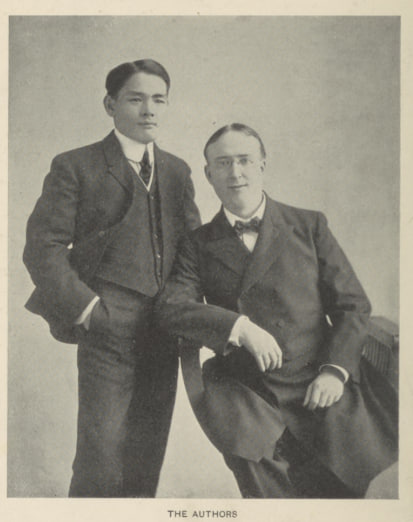
Mr. Higashi has modestly understated my reasons for wishing to have his aid in the preparation of this volume. I desired to have him collaborate with me because he is the leading exponent of Kano jiu-jitsu in this country. At the age of eighteen he was instructor in jiu-jitsu at Doshisha College, Kioto, Japan. He also coached the students in baseball, football, and other sports common in this country, and was besides instructor in mathematics.
H. Irving Hancock.
New York, March 10, 1905.
---
It is with a great deal of pleasure that I have joined Mr. Hancock in the preparation of this, the first complete and authentic work in any language that explains the highest school of jiu-jitsu as that art is taught and practised by the adepts of Japan.
Years ago Mr. Hancock was a familiar figure in the jiu-jitsu schools of Japan. He was always an admirer of our race, and has shown keen insight into many phases of our national life as we ourselves understand it. Of jiu-jitsu he became a zealous disciple, both on account of its value as a means of physical training and as a method of combat.
When he came to Japan Mr. Hancock was more than ordinarily well versed in the ways of jiu-jitsu, as he had learned much from Japanese in this country. In the schools of our country he finished what he had begun at home. While in actual combat work Mr. Hancock does not claim rank with our adepts, he is nevertheless highly skilful in the practice of the art, and his comprehension of the theory of jiu-jitsu exceeds, undoubtedly, that possessed by any other man not a native of Japan. After having studied the work of the many older and inferior schools, my collaborator applied himself to the thorough study of the most modern and effective school of the art, the Kano system, which is to-day the real jiu-jitsu of Japan, and which has been made official by its exclusive recognition by the Japanese government for purposes of instruction in our army and navy and in our police departments.
Mr. Hancock's earlier books on the subject were intended to pave the way, to prepare the Occidental public for this final and complete exposition of jiu-jitsu as it is taught by order of our government. As I have intimated, there are many systems of jiu-jitsu in Japan, but the others are all older and less effective than the modern, eclectic Kano method. These more ancient methods have become practically obsolete in Japan. It is our racial instinct to turn to the newest and best in everything. Japanese who have learned the old and now obsolete methods have found themselves compelled to forget their hard-acquired knowledge and to take instruction all over again in the more scientific Kano methods. An adept of the first rank in the older schools finds himself helpless before an ordinarily clever student of Kano.
The Kano system, at the time of its adoption by the Japanese government, consisted of forty-seven tricks of combat and fifteen "serious" tricks. Additions and amplifications have been made by those great teachers, Hoshino and Tsutsumi, until now the complete system, as we teach it, comprises one hundred and sixty tricks. These are divided into three sections. The first includes sixty tricks of combat in strict sequence. These tricks are intended as a preparation for the more advanced tricks of Section II. In the Second Section the pupil is taught how to apply advantages that he has gained by the tricks he already knows. More scientific tricks are imparted to him, and toward its close the Second Section verges on the "serious" work of jiu-jitsu.
Section III deals with highly scientific tricks of combat. In this section we meet with the tricks by which an opponent, when absolutely necessary, is maimed or killed.
In the preparation of a work of such magnitude Mr. Hancock naturally preferred to collaborate with a native Japanese professor of the art. He has been unremitting in his efforts to have Occidentals taught jiu-jitsu properly at the outset, by ignoring the lesser and obsolete schools of the art and acquiring only the Kano system that is official in Japan. Some Japanese have been engaged in this country in teaching the work of the lesser schools. Through Mr. Hancock's praiseworthy and consistent efforts to have only the Kano system taught to Americans we have been associated in its introduction in this country.
It was natural, therefore, that Mr. Hancock should turn to myself for collaboration. We have laboured long and arduously to make this work so exhaustive that it shall have no detail lacking. We present this work to the public with confidence that no apology is needed for the length and the multiplicity of detail inseparable from the complete exposition of every phase of the Kano system of jiu-jitsu.
In these pages will be found all the parts of the work as it is now being taught by a Japanese confrere of mine to the midshipmen at the U. S. Naval Academy at Annapolis.
Some confusion has arisen over the employment of the term "jiudo." To make the matter clear I will state that jiudo is the term selected by Professor Kano as describing his system more accurately than jiu-jitsu does. Professor Kano is one of the leading educators of Japan, and it is natural that he should cast about for the technical word that would most accurately describe his system. But the Japanese people generally still cling to the more popular nomenclature and call it jiu-jitsu.
Jiu-jitsu, or jiudo, is in Japan the art of the gentleman. It is not surprising, therefore, that the highest evolution of our ancient Japanese style of combat should come about in these days through the efforts of Professor Jiguro Kano. To him we owe much, and also to Messrs. Hoshino and Tsutsumi, who, by their toil, have rounded out the Kano system to its present perfection and supremacy.
Katsukuma Higashi.
42 West 65th Street,
New York, March 10, 1905.
Each contestant shall wear coat and belt.
A contestant shall be deemed to have been defeated when his two shoulders and hips shall have touched the floor, provided that said contestant shall have reached this position on the floor through having been thrown down. (See modification in Rule 8.)
A contestant shall be deemed to have been defeated when in such position on the floor, if said combatant cannot free himself from his opponent's arms within two seconds' time.
A contestant shall be deemed to have been defeated when from any cause or causes he may become unconscious. But it is not permitted to use serious tricks when the wrestling bout is between friends. Such tricks as kicking and the breaking of arms, legs, or neck are barred.
A combatant shall be deemed to have been defeated when he has been reduced to submission through the employment by his opponent of any hold or trick.
When a defeated combatant finds himself obliged to acknowledge his submission, he must pat or hit the floor or his antagonist's body, or somewhere, with his hand or foot. This patting with foot or hand is to be regarded as a token of surrender.
When a defeated combatant pats or hits the floor, or anywhere, in token of submission, the victor must at once let go his hold.
When a combatant shall have allowed his shoulders and hips to have touched the floor, but shall have done so with the intention of thereby throwing his opponent, the combatant who has so allowed his shoulders and hips to touch the floor shall not be deemed to have been defeated.
When wrestling on a mat or mattress, it is permissible for a contestant who is on the defensive to fall in any way that he pleases; but for defensive purposes it is generally better to lie upon the back.
When a combatant lying on his back for defensive purposes shall be raised and downed again by his opponent, and made once more to touch shoulders and hips to the floor, the combatant who has been so raised and downed shall be deemed to have been defeated, but not otherwise.
1. It is understood and agreed that the jiu-jitsu man, whether he fights a boxer or contests with a wrestler, shall be allowed to use in his defence any of the tricks that belong to the art of jiu-jitsu.
2. It is further understood and agreed that the jiu-jitsu man assumes no responsibility for any injury or injuries caused by any act or thing done during the contest, and that the jiu-jitsu man shall be held free and blameless for any such ill effect or injury that may be received during the contest.
3. Two competent witnesses representing each side, or four in all, shall see to it that these articles of agreement are properly drawn, signed, and witnessed, to the end that neither contestant or other participant in the match shall have cause for action on any ground or grounds resulting from any injury or injuries, or death, caused during the contest.
In this volume all of the tricks of the Kano system are given strictly in their sequence.
The student is advised that the only way in which to learn the work is to take up each trick in its order, and to master that trick thoroughly before passing on to another.
In no other way can an effective knowledge of jiu-jitsu be obtained.
In the first place, the few feats of falling, which precede the actual work of combat, should be patiently mastered, and the reasons back of each step should be perfectly understood.
Mastery of this preliminary work will make the learning of the combat tricks possible and easy.
A good deal has been accomplished when the student has fully mastered the work that is laid down in the First Section.
He should not be in haste to pass on to the Second Section, nor from the Second to the Third.
There will be a great tendency among the more incautious readers to ignore the earlier tricks, and to take up with the much more advanced ones.
Many may feel tempted to skip over the regulation combat tricks and to take up at once with those that may be made to cause injury or death.
To such students the authors wish to state that there is but limited chance to apply dangerous tricks until the jiu-jitsian, through a knowledge of the simpler feats, has learned how to get an opponent into such position that the dangerous tricks may be effectively employed.
If the reader finds that he fumbles in a certain phase of a given trick, he is advised to keep practising at that trick until he is positive of his mastery of it.